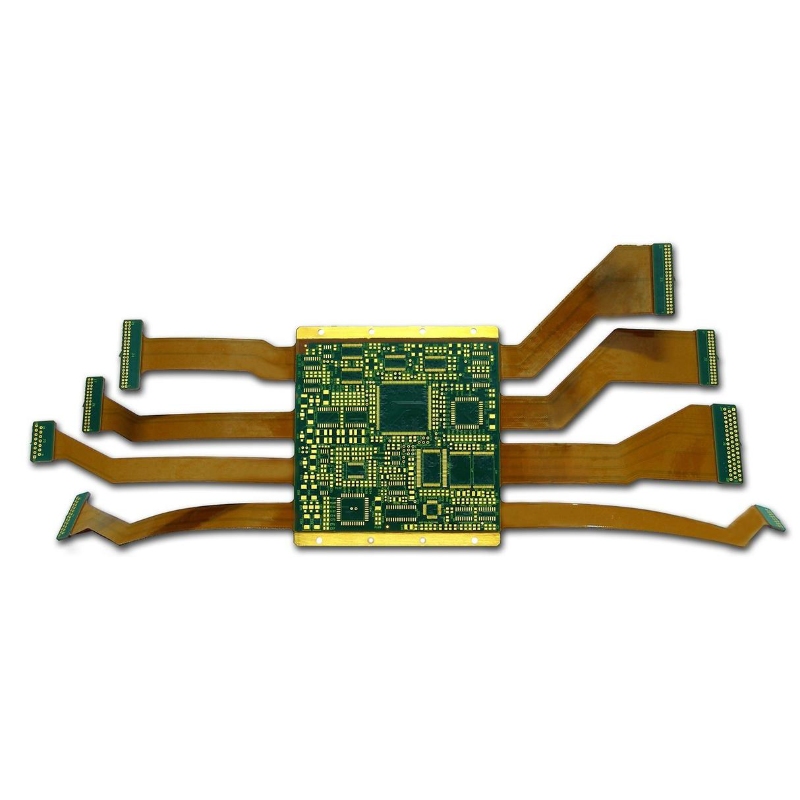
Rigid Flex PCB
Rigid Flex PCB
A Rigid-Flex PCB is a hybrid circuit board that seamlessly combines the best elements of both rigid and flexible board technologies. It consists of multiple layers of flexible circuit substrates that are attached to, and sandwiched between, rigid board layers. This integration creates a single, unified interconnect system that can be folded or continuously flexed while maintaining the shape and support of rigid boards for component mounting.
By eliminating the need for connectors and cables typically used to connect separate rigid boards, Rigid-Flex PCBs offer a reliable, space-saving, and high-performance solution for modern electronic design challenges.
A Rigid-Flex PCB is a hybrid circuit board that seamlessly combines the best elements of both rigid and flexible board technologies. It consists of multiple layers of flexible circuit substrates that are attached to, and sandwiched between, rigid board layers. This integration creates a single, unified interconnect system that can be folded or continuously flexed while maintaining the shape and support of rigid boards for component mounting.
By eliminating the need for connectors and cables typically used to connect separate rigid boards, Rigid-Flex PCBs offer a reliable, space-saving, and high-performance solution for modern electronic design challenges.
Key Features
- Hybrid Construction: Integrates flexible polyimide films with rigid FR4 or similar laminates in a single lamination cycle.
- Dynamic or Static Flexing: Engineered to withstand either continuous motion (dynamic) or one-time installation bends (static).
- High Layer Count Capability: Can support complex designs with multiple layers in both the rigid and flexible sections.
- Plated Through-Hole (PTH) Interconnects: Features robust vias that connect the rigid and flexible layers, ensuring signal integrity.
- ZIF (Zero Insertion Force) Compatible: Flexible tails can be designed with stiffeners for easy insertion into connectors.
Advantages
- Space & Weight Savings: By replacing multiple boards, cables, and connectors, Rigid-Flex designs drastically reduce the overall weight and volume of the electronic assembly—critical for aerospace and portable devices.
- Enhanced Reliability: Fewer interconnections (like solder joints and wiring harnesses) mean fewer points of failure. The system is less susceptible to vibration and shock damage.
- Improved Signal Integrity: Shorter signal paths and controlled impedance throughout the continuous circuit reduce noise and distortion compared to using cables.
- Simplified Assembly: With a single unified component, manufacturing and assembly become faster and less prone to errors, as there are no separate connectors to install or route.
- 3D Design Versatility: Allows engineers to design in three dimensions, folding the circuit to fit into irregularly shaped enclosures.
Applications
- Medical Technology: Hearing aids, pacemakers, endoscopes, and diagnostic imaging equipment where compact size and reliability are paramount.
- Aerospace & Defense: Missile guidance systems, avionics, satellites, and military wearables that must withstand extreme vibration and temperature changes.
- Consumer Electronics: Smartphones, digital cameras, laptops, and foldable devices that require high-density interconnects in a thin form factor.
- Automotive: Control units (ECUs), infotainment systems, and sensor assemblies located behind dashboards or in steering columns where space is tight and movement occurs.
- Industrial Automation: Robotic arms and precision manufacturing equipment where dynamic flexing is required for moving parts.